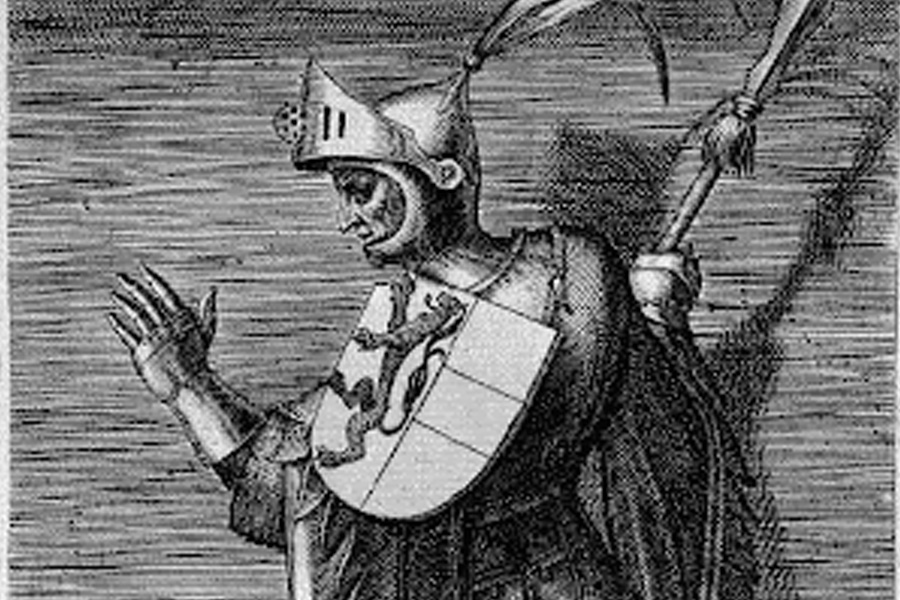
Godfrey The Hunchback is not mentioned in the history of Richard Bache Jr., Alexander Dallas Bache, or their Franklin, Dallas, Walker, Emory, and naval ancestors. This prevents me from presenting Godfrey as a family member. Instead, I use the name to begin a story about identity, memory, and the Bache family.
Richard Bache Sr. and Sarah Franklin Bache started the documented family history in Philadelphia. Their household linked business, government, science, military, and politics. The family alternated private struggle with public success for generations. Some members worked in government, while others surveyed coasts, commanded ships, shaped newspapers, or built US institutions.
The Mystery of Godfrey The Hunchback
Godfrey The Hunchback may be a fictional character, a nickname from another tradition, or a name mistakenly attached to the Bache family narrative. No biographical details in the supplied history establish his birth, relationships, occupation, or place in the family tree.
The phrase resembles a mediaeval figure. “Godfrey” conjures knights, castles, and old European tales, while “The Hunchback” conjures a memorable physical description that may have been a surname. Philadelphia, Texas, Washington, and the burgeoning scientific world of the nineteenth century dominate the Bache family story.
I find it useful to keep those two strands separate. Historical families already contain enough drama without inventing details. Richard Bache Jr. left his wife and children, traveled to Texas under a cloud of financial suspicion, served in the Texas Revolution, and later became a state senator. His son Alexander transformed American science. These facts provide a vivid narrative on their own.
Richard Bache Jr. and His Franklin Connection
Richard Franklin Bache Jr. was born in Philadelphia on March 11, 1784. His mother, Sarah Franklin Bache, was the only daughter of Benjamin Franklin and Deborah Read. This made Richard Jr. a maternal grandson of one of the most famous figures in American history.
Richard Bache Sr., from Yorkshire, England, was a merchant, maritime insurance underwriter, importer, and public officer. He succeeded Benjamin Franklin as postmaster general from 1776 to 1782. Richard Jr. was raised in a family with power from commercial offices to the top echelons of the early republic.
Richard Jr. attended the University of Pennsylvania and graduated in 1812. During the War of 1812, he organized and commanded the Franklin Flying Artillery, a Philadelphia volunteer unit. He also briefly served in the United States Navy as a sailing master.
After the war, he became postmaster of Philadelphia, probably serving from about 1815 until 1828. The position continued a family tradition that had already included both his father and grandfather. He also participated in the publication of the Franklin Gazette, a Democratic newspaper.
His life changed drastically in the early 1830s. He left Philadelphia his family for Texas. Financial issues and possible postmastership irregularities were reported, but no charges were filed. His reputation in Texas changed from troubled Philadelphia official to respected public servant.
Richard Bache Jr. in Texas
Richard Bache Jr. settled in Stephen F. Austin’s colony at Brazoria. During the Texas Revolution, he served aboard the Texas Navy vessel Zavala. On May 1, 1836, he joined the Louisiana Independent Volunteers.
After the Battle of San Jacinto, he briefly helped guard the captured Mexican general Antonio López de Santa Anna. This episode placed him close to one of the decisive moments in Texas history. His later work was less dramatic but equally important to the young republic.
From 1838 to 1839, Bache served as chief clerk of the Texas Navy Department in Houston. He also worked as enrolling clerk of the House of Representatives during the Third Congress of the Republic of Texas.
Around 1842, he moved to Galveston. There he served as commissioner of the navy yard, justice of the peace for Galveston County, and an import or customs inspector. He was also active in Masonry and local public affairs.
In 1845, he represented Galveston at the Texas Annexation Convention. He cast the only vote against annexation. Reports suggest that his opposition was personal and political, because he did not want to strengthen the influence of his brother in law, George Mifflin Dallas, who was then vice president of the United States.
Despite that vote, Bache helped draft the Texas Constitution of 1845. He later served in the Texas Senate for District 11, representing Galveston, during the First and Second Legislatures. He died in Austin on March 17, 1848, at the age of 64, and was buried in Oakwood Cemetery.
The Bache Children and Their Expanding Influence
Richard Jr. and Sophia Burrell Dallas married in Philadelphia on April 4, 1805. Sophia was the daughter of Alexander J. Dallas, who served as secretary of the treasury under President James Madison. She was also the sister of George Mifflin Dallas.
The couple had nine children. Their descendants carried the family into science, education, military service, politics, engineering, and naval history.
| Family member | Achievement |
|---|---|
| Alexander Dallas Bache | Physicist, educator, surveyor, and superintendent of the United States Coast Survey |
| Mary Blechenden Bache | Wife of Robert John Walker, a United States treasury secretary and territorial governor |
| George Mifflin Bache | United States Navy lieutenant and Coast Survey officer |
| Richard Bache III | United States Navy lieutenant |
| Sophia Arabella Bache | Wife of William Wallace Irwin, mayor of Pittsburgh and congressman |
| Matilda Wilkins Bache | Wife of General William Hemsley Emory |
| Henrietta Constantia Bache | Connected by marriage to the Abert family and military engineering circles |
| Sarah Franklin Bache | Wife of naval officer Richard Wainwright |
| Maria Campbell Bache | Wife of Allan McLane, son of Secretary of State Louis McLane |
The family tree resembles a river dividing into many channels. Each branch entered a different field, but the same currents of education, public service, and national ambition ran through them.
Alexander Dallas Bache and American Science
Alexander Dallas Bache, born on July 19, 1806, became the most scientifically influential child of Richard Bache Jr. He graduated from West Point in 1825 and later taught natural philosophy and chemistry at the University of Pennsylvania.
As a young scientist, he studied magnetism, weather, rainfall, wind, water power, and steam boiler explosions. He established a magnetic observatory in Philadelphia and investigated changes in the magnetic needle associated with auroras.
Bache also served as the first president of Girard College. Between 1836 and 1838, he traveled through Europe to study educational systems and scientific institutions. His report influenced American ideas about technical education and organized research.
His greatest achievement came in 1843, when he became superintendent of the United States Coast Survey. Under his leadership, the Survey expanded from a modest charting agency into a major federal scientific institution.
He promoted accurate coastal mapping, triangulation, hydrography, tide observation, meteorology, geomagnetism, and oceanographic research. He supported the use of electric telegraphy to determine longitude and encouraged the application of photography and electrotyping to map production.
The Coast Survey generated vital Civil War maps and charts for Union forces. Bache was on naval and military advisory committees. His efforts proved science was more than academic. It guided ships, protected harbours, supported troops, and boosted national commerce.
The Wider Family Network
The Bache family was connected to many prominent nineteenth century families. Alexander Dallas Bache was related by marriage to Robert John Walker, a treasury secretary and senator. Other relatives entered the military and naval professions.
George Mifflin Bache served in the United States Navy and died in 1846 after being swept from the deck of the survey brig Washington during Gulf Stream studies. His son, George Mifflin Bache Jr., later became a naval officer during the Civil War.
Matilda Wilkins Bache married William Hemsley Emory, a United States Army general and surveyor involved in marking the Texas and Mexico border. Sarah Franklin Bache married Richard Wainwright, who served as a naval officer during the Civil War.
These marriages created a powerful web of relationships linking Philadelphia society, federal departments, scientific organizations, the army, and the navy.
FAQ
Was Godfrey The Hunchback a member of the Bache family?
There is no documented evidence in the supplied material identifying Godfrey The Hunchback as a member of the Bache family. The name may belong to a fictional, legendary, or unrelated figure.
Who was Richard Bache Jr.?
Richard Bache Jr. was a grandson of Benjamin Franklin, a Philadelphia postmaster, military officer, Texas revolutionary, Texas Navy participant, and Texas state senator. He was born in 1784 and died in 1848.
Who was Alexander Dallas Bache?
Alexander Dallas Bache was Richard Bache Jr.’s eldest son. He became a physicist, educator, surveyor, and superintendent of the United States Coast Survey. He was also the first president of the National Academy of Sciences.
How was Alexander Dallas Bache related to Benjamin Franklin?
Alexander Dallas Bache was Benjamin Franklin’s great-grandson. His grandmother was Sarah Franklin Bache, Franklin’s only daughter with Deborah Read.
What happened to Richard Bache Jr.’s wife and children?
When Richard Bache Jr. moved to Texas, his wife Sophia and their children remained in the East. His eldest son, Alexander Dallas Bache, helped support the family and later achieved international prominence as a scientist.
Why is the Bache family historically important?
Early American politics, postal administration, military service, Texas government, education, naval history, and American scientific professional development were linked by the family. One family can impact various national institutions over generations, as shown by their narrative.
Where is Richard Bache Jr. buried?
Richard Bache Jr. is buried in Oakwood Cemetery in Austin, Texas.